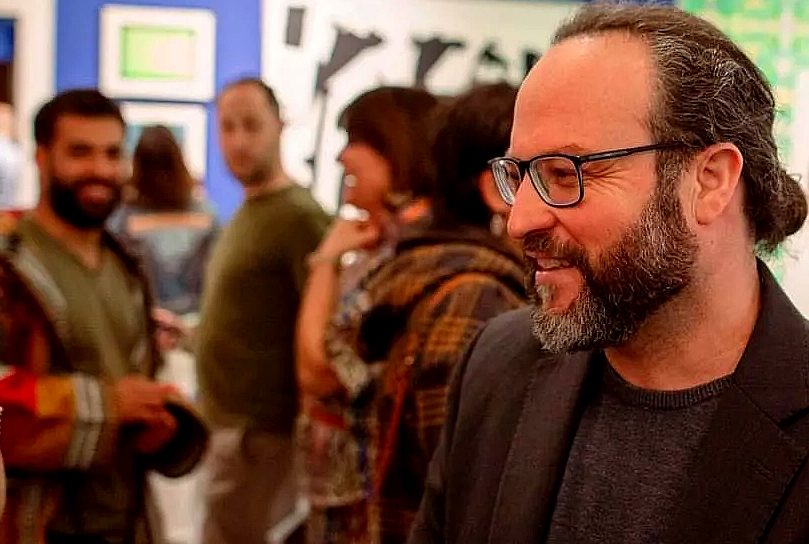
mohamed ben soltane

Visual artist, curator, and artistic director originally from Tunisia, Mohamed Ben Soltane has been living and working in Montreal since 2022. Trained at the Fine Arts Institute of Tunis, he also taught art history and directed the BAC Art Center, renowned for its socially engaged and transdisciplinary programming. His artistic practice—rooted in postcolonial studies, memory, and social critique—oscillates between mosaic, photography, installation, and text-based art.

For his new creation, Glitch in Arabic, Mohamed explores a phenomenon as subtle as it is revealing: the visual distortions that occur when Arabic text is misread by digital software. These “glitches”—separated letters, reversed direction, corrupted typography—become poetic and political fragments, reinterpreted as visual installations.

Through this project, the artist questions the symbolic forms of domination that are invisible to the eye yet embedded in digital systems. Glitch in Arabic opens a dialogue between artisanal traditions and contemporary technologies, while reaffirming the urgent need for cultural and aesthetic sovereignty in a fragmented digital world.

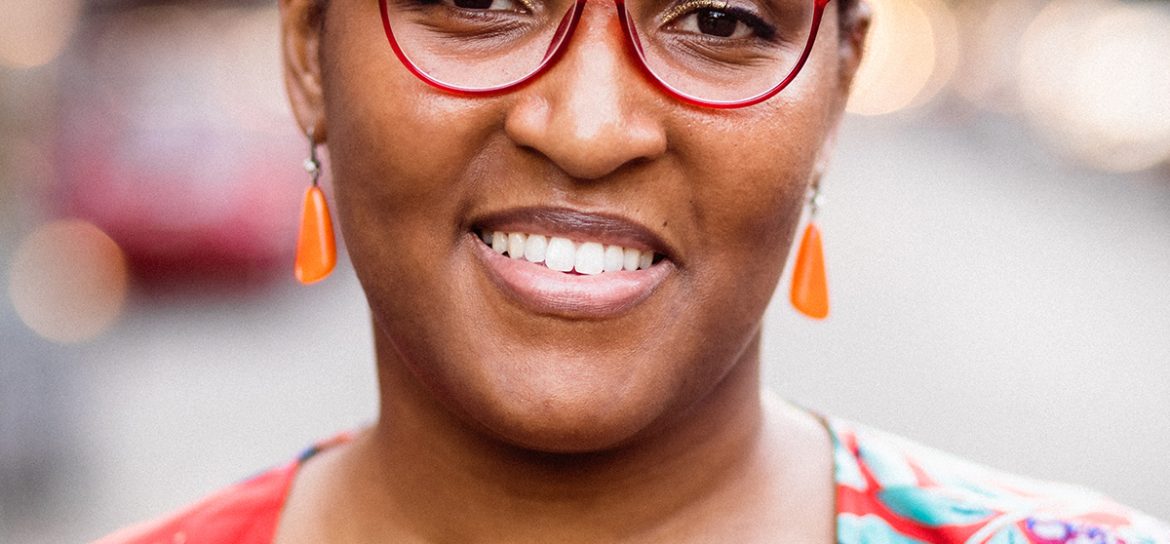
roberto santaguida

Since completing his studies in film production at Concordia University, Roberto Santaguida’s films and videos have been shown at more than 400 international festivals, including Tampere Film Festival (Finland), CPH: DOX, Copenhagen International Documentary Film Festival (Denmark), Contemporary Art Festival Sesc_Videobrasil (Brazil), Flickers’ Rhode Island International Film Festival (United States), Transmediale (Germany), and Message to Man (Russia).  He has also taken part in artist residencies in numerous countries, including Iran, Romania, Germany, Norway, and Australia.  Roberto is the recipient of the K.M. Hunter Artist Award and a fellowship from Akademie Schloss Solitude in Germany.

Summary:

I will investigate Methods of Coping — the techniques and processes implemented by artists who are facing personal challenges.  I will engage in a form of cooperative dialogue with the consultants, based on asking and answering questions to draw out underlying ideas. An area of interest I will be examining with the group is the idea of bearing witness to one’s subterranean forces instead of attempting to ignore and hide from them.


Photo credit: Yasemin Ergin

cécilia bracmort

Cécilia Bracmort is a French and Canadian artist/curator who favours the mixing of genres, transdisciplinarity and experimentation in her art and curatorial practice.

Through her multifocal vision linked to her different “layers of identity”, Cecilia Bracmort’s projects create bridges between themes to which she feels connected, such as history, identity, ecology and spirituality.

Through her artistic and curatorial work, she wants to open the door to other perceptions of the world to emerge, to encourage people to think outside the “white” box and to invite them to see the world from new angles.

In 2019, she curated the exhibition Reclaming My Place at Warren G Flowers Art Gallery at Dawson College, showcasing the works of artists Shanna Strauss, Cedar-Eve and Sharon Norwood and calling for greater visibility of BIPOC women artists in the arts community. Supported by Alliance in 2018-29, this exhibition will be presented again in 2021 at Lethbridge Center. Her new Alliance project aims at improving the visibility of her profile in the visual arts scene and refining her communication skills.

diane hau yu wong

Diane Hau Yu Wong is the recipient of 2020-22 articule + MAI joint support for curators.

Diane Hau Yu Wong is an emerging curator and art historian based in unceded Coast Salish Territories & Tiohtiá:ke territory. She graduated with a BFA in Art History from Concordia University in 2018. Her curatorial practice and research are largely based on her experience as a second-generation immigrant and the intersection between community and diasporic identity.  For the articule + MAI support for curators, Diane is examining digital futurism as a method to re-imagine a better world and sustainable solidarity among BIPOC communities through technoculture and speculative fiction. She most recently curated Centre A’s 2019 recent graduate exhibition titled (dis)location (dis)connect (dis)appearance, examining the loss of language, tradition, and culture in the diasporic community.

This partnership is supported by the Government of Quebec and the City of Montreal as part of l’Entente sur le Développement Culturel, and by the Canada Council for the Arts.